
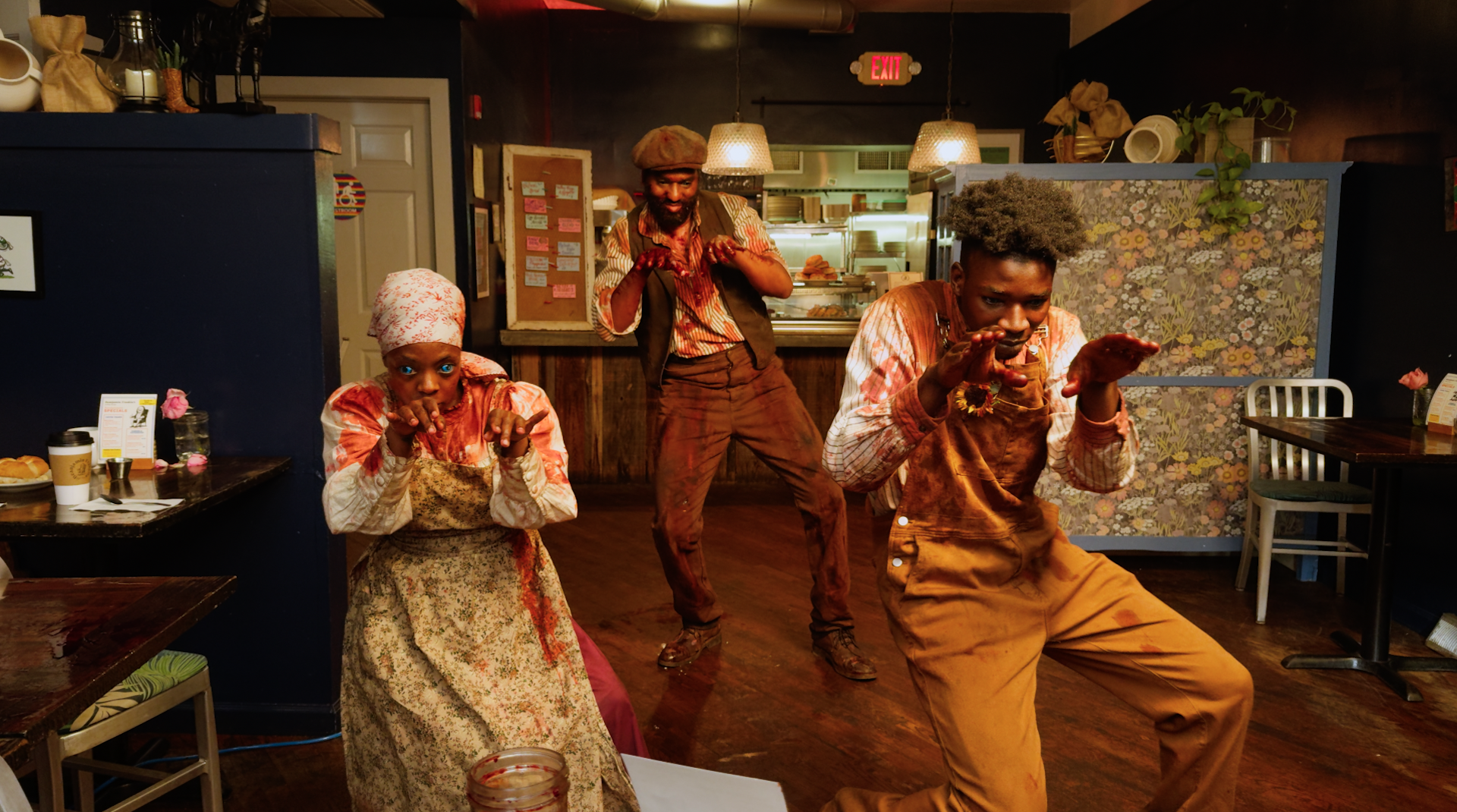
Breaking news: The world is a strange, depressing, messed-up place right now. So much so that, as history is removed from Philadelphia’s President’s House, a key location in this country’s founding, somehow it falls to a zombie horror film to help keep history alive.
Filmmaker David Dylan Thomas wasn’t setting out to make a film for the purpose of preserving history. Rather, he wanted to create a fun horror film that happened to be based in history. With White Meat: Appetizer, a horror short set in Philadelphia, he has done both.
The film, and the proposed feature for which it serves as a proof of concept, follows what happens when enslaved people from Philadelphia’s past return and subject white people in the modern day to the same treatment they endured at the time of the nation’s founding and beyond.
Thomas talked to us about his longtime love of horror and how his short unintentionally became a historical record of sorts:
Hi everyone. Welcome once again to the Scrappy Cinema podcast. I’m your host, Ryan Ritchey, and joining me today is the writer and director of the horror short, White Meat: Appetizer. David Dylan Thomas joins me to talk about the short and how it ties into his love of horror and a little bit of history as well. David, thanks for joining me today.
David: Oh, my pleasure. Thanks for having me.
So before we get too far into this, let me hear, in your own words, what is White Meat: Appetizer?
Sure. So White Meat: Appetizer is a horror short based on the following premise: underneath Washington Square Park in Philadelphia are buried the bodies of hundreds of enslaved people, which is actually true. What if one night they all come back from the dead as zombies, but they only eat white people?
And this short—of course, your main plan here is to create a feature, correct?
Yeah. So I wrote a feature a couple years ago, after years of writing and research, called White Meat. It takes place in Philly and has the same premise, but is more expansive than the short. The short just takes place in a coffee shop. Once we finished the screenplay and started trying to raise funds, we realized we really needed that proof of concept to get the vision in people’s heads. So we made this short. We’ve been taking it all over the country—really, all over the world. We had a screening in India last year. We’re trying to raise interest so that when we do start asking for money for the feature, it’s more in the public eye.
And I’d like to digress a moment to talk about your other work away from making short films—your research around cognitive bias and that sort of thing. How does that affect your filmmaking and how you approach this short?
Oh, it’s funny. I studied cognitive bias in an effort to write a book called Design for Cognitive Bias, which came out a few years ago. My background prior to all of this is in what they call content strategy and user experience, so helping build websites. I became fascinated with the psychological aspect of that, and I wrote a book called Design for Cognitive Bias.
Cognitive bias is basically the fact that we have to make a trillion decisions every day. Even right now, I’m deciding where to look, how fast to talk, and what to do with my hands. If I had to think about every single one of those decisions, we’d never get anything done. So a lot of our lives are on autopilot. The downside is, depending on the biases you grow up with, autopilot could mean, “I don’t trust that Black guy,” or, “I don’t think that woman’s capable of that job.” Not in an explicit “that’s what I believe” kind of way, but more in a, “There’s a woman’s name at the top of that résumé, so I’m going to be a little more skeptical” way that you don’t notice. That’s the far more common form of bias, although explicit biases absolutely exist.
All of that informs my approach to moviemaking. When I think about character, for example, I think about how much of their choices are conscious—things they’ve actually rationally thought through—and how much is a background script that’s running without them realizing it and helping them make potentially very poor choices. It helps me talk to actors about the psychology of the character and the influence of the environment on the character. I think that’s one place it helps to have almost a forgiving, generous grace around why people are acting the fool right now.
And I also wanted to mention that you have an interesting framing device or setup here with the social-media aspect, almost like a TikTok challenge, to get us into this situation in the film. I’m curious where that comes from.
Sure. The film itself is told from the point of view of a content creator named Randy. Randy’s shtick is that he is a Black man who goes into white spaces and doesn’t order anything. In this case, he goes to a coffee shop and waits to see how long before they kick him out. He even has a control: a white friend who is also there and not ordering anything. He waits to see which one gets thrown out first.
It’s funny, too, because I found out later that this is something Bayard Rustin, the famous civil-rights leader, basically did a version of back in his day—just without the TikTok. While Randy is filming, the whole thing is filmed like 9:16, vertical. While he’s in the middle of filming, that’s when the zombie attack happens. That’s the framing device.
Initially, I didn’t want to do a short. I really wanted to write the screenplay, sell it, and make a feature. I didn’t want to mess with shorts. I was afraid of cannibalizing—pun intended—anything from the feature. I didn’t want to shoot a scene from the feature and then have to shoot it all over again, recast it, and deal with all that weirdness.
But a short-film contest came along and lit a fire under my ass. I thought, “Well, if I did make a short, what would it be?” I had this old skit idea, like a Key & Peele-style skit, called “Extreme Sports for Black People”. If extreme sports for white people is, “I want to jump out of a helicopter and ski down a mountain,” what would get my adrenaline up as a Black man? Going to a Starbucks and not ordering anything. That would be really tense. There would be newscasters in the corner saying, “Oh, he hasn’t even ordered water yet. Oh, this guy is so extreme.”
Once I remembered that and realized it was its own little contained short, I thought, “What if that’s when the zombie attack happens?” It married well. Once I had a week or two to think about it and watch that movie in my head, the short came together very quickly. I wrote it in about an hour and a half once I finally put the pieces together. That’s why it has that particular framing.
It’s fascinating because that feels like such a contemporary issue, and for you to have found the historical background of this—obviously it’s not a new problem—the fact that people have been recognizing it as an issue and noting it happening for decades is interesting to me. Speaking of noticing things as issues, your film is set in Philadelphia. I think for a lot of people in Philadelphia, there’s a feeling that slavery was something that happened somewhere else, that it wasn’t part of Philadelphia. “That’s the South. They were wrong. Why did they do that? Our hands are clean.” Why was it important for you to set this in Philadelphia?
Well, I think part of it is my own ignorance. There’s a line in the movie where the main character is marveling that there were enslaved people in Philadelphia, and another character has to explain, “What are you talking about, man? They’ve been here the whole time.” Even for me growing up, I had this illusion that the North is the North and the South is the South.
As you grow up, and hopefully learn more about history—and that’s honestly part of my project with this movie—you realize that not only were there enslaved people in the North, but the North itself was extremely complicit. Someone had to write all the checks for the loans that created the plantations and buy the goods. This was a symbiotic system. Not to mention Europe’s involvement. It’s a whole ecosystem. Think about oil: every country in the world is involved in oil. Cotton was the oil of its time.
Once I saw this, it was good to tap into things like the President’s House, where George Washington would stay when the capital of America was in Philadelphia. There was a house right next to where we keep the Liberty Bell now, and that’s where he kept his enslaved people, because he had plenty. One of them was named Ona Judge. She escaped from him, and he spent the rest of his life going after her. Think about that: a guy who is sort of the founder of liberty spends his whole life trying to get the one human being who got away, insisting that she can’t be free.
All of those contradictions live in Philadelphia, the same way they live in almost every major American city—in America itself. The idea that slavery is over, so why do we have to bring that up, or that slavery certainly never happened in Philadelphia, needs to be challenged. We’re never going to progress if we have illusions about our past. We’re only going to progress if we actually know what happened.
In a larger sense, the effects of slavery are contemporary. We’re living through them now. If you look at the way this administration is behaving, it is behaving very much like administrations that endorsed slavery and are trying, in their own way, to get us back as close to that as possible. It’s no coincidence that the President’s House, which explicitly showed the history of the enslaved people there, had that material removed by the Parks Department at the President’s request. We tried to preserve some of it in the credits of the movie.
This is a very contemporary fight—not only understanding that Philadelphia is as complicit as any city you want to pick, but temporally as well. Now is very much the result of then, and we haven’t really dealt with then. We are not far away from this. We are in it.
And just as a quick aside, I wonder sometimes if that whole President’s House debacle wasn’t a bit of a Streisand effect, where more people are aware now than they would have been had they just left it.
You know, it’s unfortunate in that I wish he wasn’t doing any of this. I wish none of this was happening. But the ironic part is that because it’s happening, all of a sudden my film has more relevance. I don’t want it to have to. At best, I want putting the names of the slaves George Washington owned in the credits to be a sick joke, or a “did you know?” What it’s turned into, inadvertently or not, is one of the few places now where you can actually find this information because they’re trying to rip it down from the place it’s supposed to be—in a museum.
Instead, a zombie horror short is going to be where you learn this history. On the one hand, it’s absurd, but it is kind of the mission: to say, “Look, I don’t know that you’re going to get this history anywhere else. Maybe a horror short is going to be your easiest avenue right now.”
And I also think there’s something to be said for the fact that you don’t expect to learn a lot of history when you go in to see a horror short. You’re doing this unique service of bringing history to an audience that’s not expecting it. One of the best things when you’re at a film festival, especially with a lot of shorts, is that you have no idea what’s coming up. You don’t know anything about what you’re about to see. Why was it so important to you to present history in a way that makes people want to leave and maybe try to find out more?
I think it’s because I like to learn. I love entertainment. I want to be clear: this is something I’ve learned from every filmmaker or creator whose work makes me feel like I’m learning. The Good Place, for example—I’ve learned so much philosophy from watching The Good Place. I love watching it because it’s hilarious, but I also love the little bits of philosophy and the conundrums you can get your teeth into. Michael Schur is a huge philosophy geek, so he did that. But he’ll tell you, “I am not making this to teach you philosophy. My number-one responsibility to you is to make you laugh.” If he isn’t doing that, it doesn’t matter what the philosophy is.
I’m in tune with that. I’m making a horror comedy. I’m scaring you and making you laugh. If I’m not doing those two things, why are we here? However, all of that comes from things like, “Did you know that the Quakers, before they became abolitionists, kind of owned a bunch of slaves?” Those little things are driving the horror. Thematically, I want to be coherent as an artist.
They say make what you like. I like entertainment that is effective both as a piece of genre and as a piece of education. To me, when I’m learning something, I’m more engaged if it’s done right. People talk about how terrible exposition is in movies, and I’m like, “I love exposition as long as it’s good—as long as it’s entertaining.” You watch YouTube and TikTok videos: that’s just a person talking to a screen, but if they’re doing it right, I’m there, and I’m going to the next one and the next one. Don’t tell me exposition isn’t entertaining. You have to make it entertaining. You have to do your job.
I love learning stuff—the feeling I get when I’m learning. To me, that’s what good cinema is: doling out information a little bit at a time. That’s why it was important to me. That’s what I enjoy watching as a filmmaker. We live in a hellscape, and we need to learn to be in the hellscape. They’re both kind of in sync right now.
I’m never sure if it’s reassuring or more depressing to learn about atrocities of the past. I don’t know if it makes you think history is repeating, or if there’s some value in getting out of this “unprecedented times” mindset because, in a lot of ways, we’ve seen horrible things before.
Yeah. I wonder if this is something unique to horror fans, or a tendency for horror fans, because I have other friends like this. When things are going terribly in the world, there are a lot of responses. One end of the spectrum is, “I just need some cat videos. Please let me escape completely into a world where nothing is happening.” On the other end are people who say, “Oh, this is terrible. I want to watch Night of the Living Dead.”
There’s a weird comfort in taking the horror and making it more extreme. Maybe it’s, “Well, at least there aren’t actually zombies eating everybody right now—yet.” Or maybe it’s a way to make sense of and process feelings of fear, because fear is the primary emotion of horror. Horror gives you a way to play with fear and process it.
I’m definitely on the side of, “They’re storming the Capitol; I’m going to watch Apocalypse Now,” because that makes more sense to me. That’s going to be my break from all this coverage. That’s literally what I did. On January 6, I can account for my whereabouts. I had taken a nap that day, and when I woke up, it was in the middle of the horror. I watched about an hour of coverage before thinking, “Okay, this doesn’t make sense. I can’t.” I was in the middle of watching Apocalypse Now, so I went back to that, because it actually felt more sane and less chaotic than what I was watching.
When we look at atrocities of the past, one way I process them is to say, “Okay, I’m going to make this horror, but I’m going to make it authentic.” A lot of what I do in my horror is not present anything that hasn’t actually happened. Rather than invent some new horror that will be unleashed on the white residents of this city, White Meat simply takes what was done to the Black residents of that city and does it to the white residents. The tagline is, “When it happens to white people, it’s horror. When it happens to Black people, it’s history.” I really push that juxtaposition. There’s the standard fare—the zombie is coming and going to eat you—but that’s not the worst thing the zombie is going to do.
Let’s go back and talk a little bit about the nuts and bolts of making this film. It looks great. What did you shoot on? How long did you need to shoot? How did it all come together?
Sure. I want to shout out my amazing crew. Jalen Ramseur-Williams was our DP. My producer, Stephanie Malson, is a miracle worker who brought the cast and crew together. I bring it up because I always want to highlight that we did our best to pay our cast and crew well. Part of the reason it was more expensive than a short usually is, is because we made sure we were paying at least union level, even if you weren’t in the union. Respecting labor is very important to us. We literally have a manifesto to that point on the website that says, “This is a movie about the exploitation of labor. It would be the worst irony to exploit labor to make it.”
Part of the reason we have the quality we do is that we hired professionals to do their jobs well, and we gave them the economic means and freedom to focus on making this thing. I always want to highlight that.
We had an amazing cast and crew, and it also gave us the luxury of time to go into preproduction and thoroughly think about how we wanted to shoot it and what we wanted the production design to be like. The look of the film comes from two places. One is Jalen Ramseur-Williams, our DP. We talked about whether, if we were going to shoot in the 16:9 or 9:16 format, we wanted an actual iPhone or wanted to take a normal camera and block it off. We played around and discovered the iPhone was the best option. We shot on an iPhone 16.
Pro tip, if you want to save money, all I’m going to say is that Amazon has a 90-day return policy. Anyway, we shot on an iPhone 16, but we had a little rig for it to add a neutral-density filter and give us a few more options, battery power, and all that stuff.
Part of the reason we went with that is because we want the audience to believe it is Randy holding this phone. If it’s a normal camera, you kind of have to hold it differently. The camera movement feels more realistic when it is coming from an actual iPhone. You have to hold it in a way that fits the motion better.
What was really fun is that everything focused back at Randy is operated by Randy—the actor is the camera operator. When it’s pointing out, it’s Jaylen, our DP, and Jaylen is now Randy. He has to behave the way Randy would. He has to move the camera the way Randy would. We had a fun rehearsal with him, Devon, who plays Randy, and myself, in my kitchen. We played around with going under the table and thought through, “At this point Randy is under attack. How is he going to move the camera?”
That was a really fun, unexpected joy of working on this: pushing the boundaries of whether a DP can also be an actor.
That insight about how you hold the iPhone—and trying to fake that with a camera, just the shake, the fact that you’re operating from your wrist with the phone versus using both hands—I think that’s really interesting. I have to be honest with you: this is the first portrait 9:16 thing I’ve seen in the theater that wasn’t terrible. It makes sense. Why he’s doing this makes sense, and it totally fits with what’s going on. For the feature, would you stay with that? Would there be certain scenes from the phone? How would you handle that?
No. The feature was written to be a good, old-fashioned Panavision, as wide as possible. This is a movie. Stylistically, it definitely wants to evoke blaxploitation—Blacula, those rich reds and browns and yellows, that kind of look. That’s definitely what I’m going for cinematically. We even tried to mimic that a little bit.
The other person who really lent to the visuals was our colorist, Kent Ichikawa, who did an amazing job of bringing out the vivid reds and all that. Even though it was shot on an iPhone and looks like it was shot on an iPhone, we bumped it up a little. It’s a little richer. It feels a little more like a film.
I definitely want to keep that for the feature. But White Meat is meant to be a more standard, big widescreen horror movie. I think I will put in an Easter egg that is either footage from Appetizer or an interview with Randy. There’s a scene in the movie where they go to a bar and TV screens are showing what’s happening outside. I’m thinking one of those might be an interview with Randy or something. There’s definitely room to take some elements from Appetizer and bring them into White Meat. But White Meat is going to be a much more standard frame.
You’re about midway through the festival circuit with White Meat Appetizer, right? You have a few more shows coming up. What has that experience been like? I assume you’ve been attending several of the festivals. What has the feedback been like, and what has your experience been on the festival circuit?
Oh, it’s been fantastic. We’ve gone to, I want to say, seven or eight festivals at this point. We’ve won about seven awards total. It’s been fantastic.
The number-one great thing is just watching it with an audience. Whether it’s a big audience or a small audience, seeing people react to it, seeing the different reactions, and feeling that energy—there’s nothing like it. Even for a short film, there’s nothing like seeing it in a theater, a classroom, or whatever the setting is. I’ve watched it in coffee shops before. There’s nothing like that feeling.
The second-best part is meeting people—meeting fans, filmmakers, festival producers, and just talking to people who love film and are trying, by any means necessary, with that same indie spirit. The scrappy-cinema vibe is great. You also learn about the industry. Especially when I go to festivals in L.A., I’m talking to people who, on one hand, are doing the indie thing to get their movie made, but whose day job might be as an extra on The Mandalorian. They’re in the industry as well as not, which is a really interesting perspective.
The best part has honestly been watching it with audiences and meeting people. When I say fan, I mean both as a fan myself and the filmmakers who are also fans, talking to them about stuff. It’s expensive to do this, and I’m fortunate to be in a position where I can afford to attend and apply to a lot of these. That isn’t cheap either. But the payoff for me is that fan experience.
The horror community in particular is so welcoming. It’s a cliché, but some of the most welcoming fans you’re ever going to find are horror fans. It’s been great.
I don’t watch a lot of horror, and I was pleasantly surprised to learn over the last year just how welcoming that community is. I did not expect that. In the rest of indie cinema, there can be some silos and cliques. It feels like the horror community is very welcoming and very supportive across the board, whether it’s your first film or your tenth.
Yeah. Again, that’s something I discovered by going to these festivals. The other thing I’ve discovered is that it is really rich. There is a great Black horror community, especially in Philadelphia. There’s a great Black woman horror community and queer horror community here. Not only is it welcoming in general, but it can be very inclusive in terms of the people who, especially in this day and age, are being discriminated against and whose voices people are trying to eliminate.
Where I’ve seen the most Black women filmmakers is actually in horror right now, at the moment—just the people I personally know. It’s a great movement to see. I think that’s been the other great discovery of going to these festivals and events that might not actually be at a festival: discovering this rich creative community of color and queer creative community specifically within the horror genre.
I don’t think it’s any coincidence. There are podcasts galore about how horror is a home for the edge, for the boundary, for the places where people aren’t accepted—where you can say things in the mask of horror that you’re not really allowed to say in a drama, or can kind of get away with in a comedy. Horror can be like, “Oh, there are vampires here. What are you complaining about?”
I know you’re also a Black-horror history buff, and you obviously enjoy encouraging people to learn about history. To that end, I want to thank you because, as a result of this interview, I watched Sugar Hill for the first time this week.
How you doing? (laughs)
I am good. I am good. So thank you for that. One thing I did want to touch on is that I heard in another interview you did this interesting history about how zombies were portrayed in the early films. Talk a little bit about that.
Sure. Before we begin, I really want to shout out a movie that just came out. I don’t know when this episode is coming out, but on September 11th of this year, a movie called Black Zombie—a documentary about exactly this topic—came out, and it’s fantastic. If it’s in your local theater, see it. If it ever comes to streaming where you are, watch it. Keep an eye out for it. It’s fantastic.
It is this history. There’s a book I read called The Half Has Never Been Told, which is about the economic history of slavery. At one point, it talks about the origin of the term “zombie” and how, in Saint-Domingue—which becomes Haiti and is adjacent to Haiti back in the day—it was a term Black people used for a body possessed by a white wizard to do labor. That is the early zombie.
If you go to the first zombie movie, White Zombie, Bela Lugosi plays a character named Murder Legendre—that is his actual name. He runs a plantation populated by people he has raised from the dead to do labor on his sugar mill. Literally, when you watch this movie, what the zombies are doing isn’t eating people. They’re turning a mill. They’re carrying sacks of sugar cane. They are slaves. Zombie means slave. That’s what it is.
It stays that way up until the 1960s, when Romero flips the table and turns them into flesh eaters. Zombies become a very potent metaphor for possession of the Black body, extraction of labor, capitalism, exploitation, and all these things. But because they are being told through a white lens, they are also the bad guy and the evil, and you don’t want to deal with them.
Only recently are we starting to see attempts to reimagine that. The other piece is a demonization of African religion. All the zombie stuff the bad guy in White Zombie is doing is an appropriation of this “Black magic.” He is the bad guy, but part of the reason he is the bad guy is because he is doing stuff with this supposedly bad religion. It becomes, “White dude, why are you messing with this African religion? African religion is bad; you shouldn’t do that.” The African religion is as much the villain as Bela is.
Not for nothing, all this is happening while the U.S. is occupying Haiti. It’s not a coincidence. It’s like, “See, these Haitian people can’t be trusted. It’s good that we’re there. Look at what they do if we weren’t there.” It’s all very seedy.
That is the origin of the zombie, both in terms of legend and writing. This guy Seabrook wrote a book called The Magic Island, which is super anti-Haitian propaganda—very racist—but it became a huge book and part of the fascination with Haiti. That’s how you get White Zombie, and it goes from there.
That origin was fascinating to me. Once I learned it, I thought, “We’ve got to bring this into the story.” I want to seed it in White Meat, the movie. We hint a little at the type of zombie we’re dealing with in Appetizer, because we get a sense that the zombies might not want to be doing what they’re doing. There’s this idea of will at stake.
What is something you learned in making White Meat: Appetizer that will help you in future projects?
I think I’ve always been a collaborative director, but what I learned on this one is really the degree to which you can trust the balance between your vision and your colleagues’ visions. I have an idea, I write a script, and this is the thing I want to bring to life. The way I’ve found that I work best is that I say, “Okay, here’s the vision. You are a director of photography. I’m going to give you the idea of what I’m looking for, but now you bring to it what you’re going to bring. You are the costume designer; you bring what you’re going to bring.”
What I love—and what I’ve learned I love—about filmmaking is the surprises. I have this idea for how it’s going to work, and if I’m working with the right people and I’ve established a good relationship, they’re going to bring their stuff to it that completely surprises me.
Isaac’s cap in the costume design: there’s one main zombie, and he has this little cap. When he put that on during the costume fitting, it was like, “You just became Isaac.” That’s not in the script.
My editor, Raquel Davis, is amazing. Because the story is told in real time, theoretically there isn’t that much room to edit around—it’s all supposed to be one linear shot, effectively. Still, I said to her, “Hey, wherever you can, I want you to surprise me,” and she did. There’s a moment in the movie—I don’t want to give it away; you’ll know when I say, “as we transition into the zombie attack”—but the thing that happens is not in the script. It’s one of my favorite parts of the movie. She just said, “Oh, you know what we could do here?” and did this thing.
What I’ve learned from this process is the degree to which you can collaborate. I think part of it is that I’ve never worked with this many people before. Usually it’s just five of us saying, “Okay, let’s run over here before the cops come.” But the degree to which you can trust—and the movies within movies people are able to create by bringing their whole selves to it—that’s been a revelation to me. I will definitely take it forward into my next movies.
I really want to work with people who are going to surprise me, challenge me, and show me what the movie could be, because no matter how big, expansive, or in love with my idea I am, it can always be better. This movie taught me that more than any other movie I’ve worked on.
Well, the movie itself is surprising and challenging—more eye-opening, I would say—and really enjoyable. I would encourage anyone who has it playing at a film festival near them to check it out. They can find out more at WhiteMeatMovie.com, and of course we look forward to the feature down the road as well. David Dylan Thomas, writer-director of White Meat: Appetizer, thank you so much for joining me today.
It’s been my pleasure.
Until next time, everybody, stay scrappy.